
Most business owners in Louisiana treat the sale of their company like a slow-cooked gumbo.
They think if they just let it simmer long enough, the right buyer will eventually wander into the kitchen.
That’s a mistake.
In the world of louisiana business brokerage, time is either your greatest ally or your most ruthless enemy.
The longer a business sits on the market, the more "stale" it becomes. Employees start to whisper. Competitors start to circle. The perceived value begins to leak.
You don't need "eventually." You need a roadmap.
When you decide to sell, you aren't just looking for an exit; you’re looking for a structured transition that protects your legacy and maximizes your wealth.
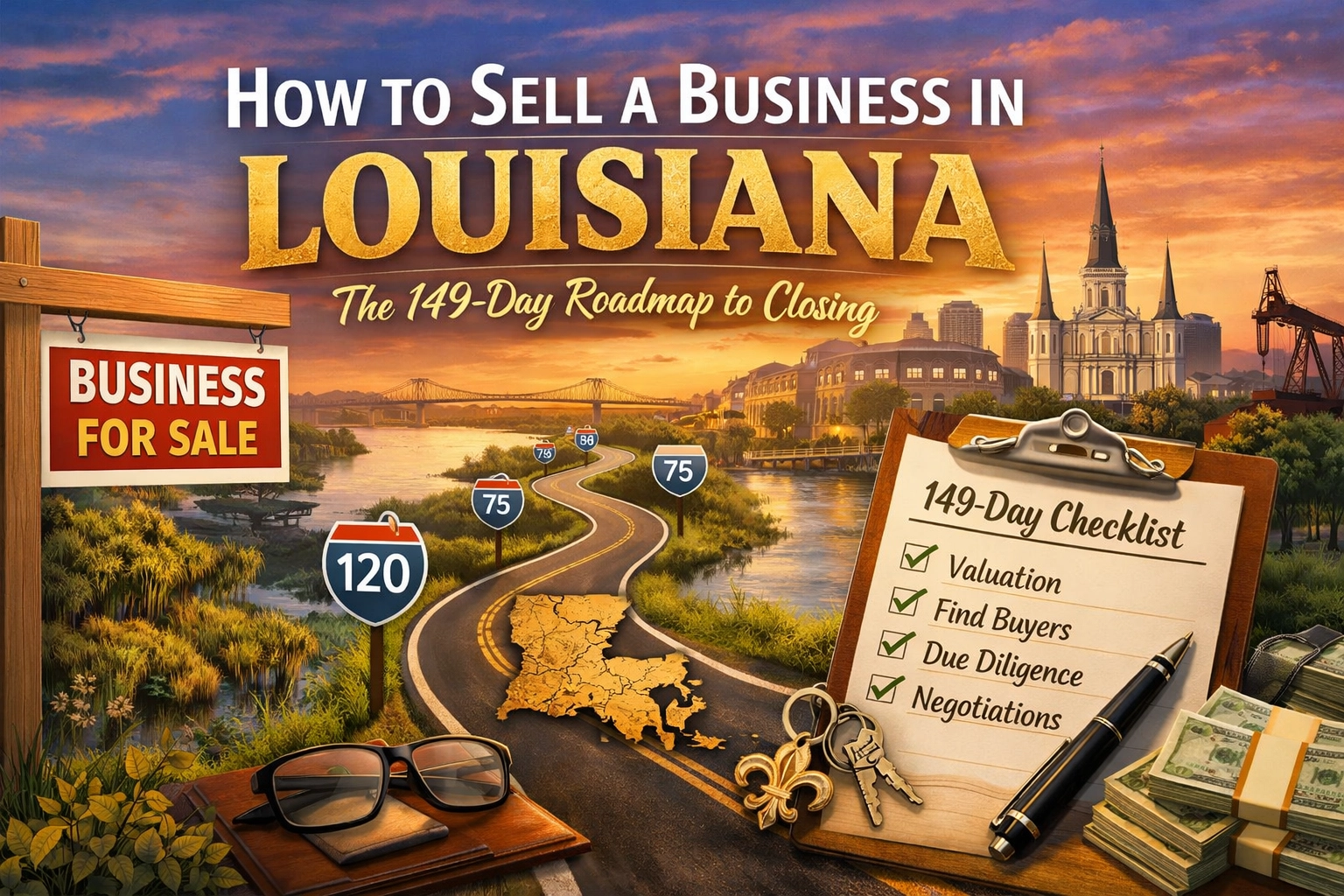
Based on market data and the reality of the current M&A landscape, we’ve identified a specific timeframe for success: 149 days.
It’s not a magic number. It’s a disciplined sprint.
Here is how you navigate the path from "Thinking About It" to "Closing Day."
The Psychology of the 149-Day Sprint
Why 149 days?
Because roughly five months is the sweet spot between thorough preparation and maintaining market momentum.
It’s enough time to conduct deep due diligence on yourself, but not so much time that you lose focus on actually running the business.
Selling a business in Louisiana requires a unique blend of local market savvy and national reach.
Whether you’re running an oilfield services firm in Lafayette, a logistics company in New Orleans, or a manufacturing plant in Shreveport, the steps remain the same.

Phase 1: The Foundation (Days 1–30)
You cannot sell what you cannot prove.
The first 30 days are about Clarity.
Most owners have a "number" in their head. Usually, that number is based on what they need for retirement or what their neighbor’s cousin said their business was worth.
The market doesn't care about your retirement goals. It cares about transferable cash flow.
Step 1: The Valuation
You need a professional valuation that mirrors how a buyer (and their bank) will look at your books. This is where we look at your "SDE" (Seller’s Discretionary Earnings).
If you want to understand why this is the most critical step, check out why business valuations matter more than most Louisiana owners realize.
Step 2: The Documentation
Gather three to five years of tax returns, P&L statements, and balance sheets.
Verify your leases.
Check your vendor contracts.
If a buyer asks for a document on Day 100 and you can't find it, the deal slows down. And slow deals often die.
Phase 2: The Packaging (Days 31–50)
This is where the how to sell a business in louisiana process gets creative.
We don't list your business on a public forum with your name and address. That’s how you lose your best employees and your biggest clients.
Instead, we create a "Blind Profile" or a "CIM" (Confidential Information Memorandum).
The Confidentiality Advantage
Here is a hard truth: Being "local" can sometimes be a liability during the marketing phase.
If your local broker is "shopping" your deal at the same country club where your manager plays golf, your confidentiality is already gone.
At Business Broker Louisiana, we leverage the fact that we aren't tethered to a single city office.
We work with firms like Vision Fox Business Advisors to ensure that your business is presented to qualified buyers across the country, not just the guy down the street.
This creates a "shield" of confidentiality. Buyers from Texas, Florida, or even the Midwest are often looking to enter the Louisiana market, and they represent a massive pool of capital that local-only brokers often miss.

Phase 3: The Market Strike (Days 51–90)
Now, we go to market.
This isn't about getting a buyer. It’s about creating competition.
In Louisiana, we see high demand in sectors like healthcare, specialized construction, and maritime services. But the best buyers often come from outside the immediate area.
Vetting the "Tire Kickers"
Not everyone who signs a Non-Disclosure Agreement (NDA) is a real buyer.
Some are competitors looking for trade secrets.
Some are "searchers" with no actual funding.
Our job is to gatekeep. We protect your time so you can keep your revenue up.
If the revenue drops while the business is on the market, the buyer will use it as leverage to drop the price.
Control is maintained through scarcity and vetting.
Phase 4: The Letter of Intent (Days 91–110)
By Day 90, we should be looking at a Letter of Intent (LOI).
An LOI is the "engagement ring" of business sales. It’s not the marriage, but it’s a serious commitment.
This document outlines:
- The Purchase Price.
- The Deal Structure (Asset vs. Stock sale).
- The Due Diligence period.
- The "Exclusivity" period (where you stop talking to other buyers).
This is a high-stress moment. Many owners feel the urge to rush. Don't.
This is where you decide if the buyer is a cultural fit for your team and if the financial structure actually secures your future.

Phase 5: Due Diligence & The Deep Dive (Days 111–140)
This is the "Proving Ground."
The buyer’s accountants and lawyers will go through your business with a fine-toothed comb. They are looking for reasons to "re-trade" (lower the price).
Common pitfalls in Louisiana specifically include:
- Environmental Issues: Particularly for industrial or agricultural businesses.
- License Transfers: Ensuring occupational licenses or specialized permits (like liquor or health permits) are ready for the handover.
- Successor Liability: Ensuring the buyer isn't inheriting your past tax debts.
This is why preparation in Phase 1 is so vital. If your house is already clean, this phase is just a formality. If it's messy, this is where deals fall apart.
If you’re feeling overwhelmed by this stage, you’re not alone. It’s a primary reason why selling feels harder than it should for Louisiana business owners.
Phase 6: The Closing (Days 141–149)
The final week.
The lawyers are arguing over commas in the Purchase Agreement.
The bank is finalizing the wire transfer.
The "Certificate of No Tax Due" from the Louisiana Department of Revenue is in hand.
Closing isn't just a signature; it’s a transfer of risk.
You hand over the keys; they hand over the life-changing check.

Why Location Doesn't Define Your Broker
A common misconception in the louisiana business brokerage world is that you need a broker with an office in your specific zip code.
In reality, the opposite is often true.
Selling a business is a global transaction disguised as a local one.
When you work with a firm that has a broader reach: like our partnership with Gulf Coast Business Broker: you gain access to a wider net of buyers.
More importantly, you gain an extra layer of privacy.
When a "non-local" advisor manages the process, it’s much harder for the local grapevine to figure out who is for sale.
We represent owners across the state and the broader U.S., focusing on the outcome rather than the proximity.
The Cost of Inaction
Many owners wait until they are "burned out" to start this 149-day clock.
That is the most dangerous position to be in.
When you are exhausted, you lose leverage. You become desperate for the exit, and buyers can smell it.
The best time to start the roadmap is when the business is thriving and you still have the energy to lead it through the transition.
Selling a business in Louisiana is a complex maneuver, but it doesn't have to be a mystery. It’s about moving from a state of "Hope" to a state of "Certainty."
Your Next Step: Visibility
You don't need to list your business today.
But you do need to know where you stand.
Before you start the clock, you need to understand the current value of your life’s work.
Take a look at selling a business in louisiana: what owners should know before they list to get your head in the right space for the journey ahead.
The 149-day clock starts whenever you're ready to take control of your exit.
Are you ready to see the roadmap for your specific company?
Let’s get to work.